New Moon won Movie of the Year at the 2010 MTV Movie Awards, held on June 6. We now have pictures of New Moon-ers Alex Meraz (aka Paul), Chaske Spencer (aka Sam), Jackson Rathbone (aka Jasper Hale), Kiowa Gordon (aka Embry), Nikki Reed (aka Rosalie Hale), Peter Facinelli (aka Carlisle Cullen), and Elizabeth Reaser (aka Esme Cullen)!
MTV just revealed where Kristen Stewart and Robert Pattinson will sit at the MTV Movie Awards Sunday night!
As we know, Kristen Stewart, Taylor Lautner and Robert Pattinson will definitely be present to introduce a brand new, exclusive “Eclipse” clip, and now we have the awesome ability to picture where they will be sitting in the audience before they grace the Gibson Amphitheatre’s stage! Note the empty seat between Rob and Kristen … perhaps that’s for Taylor or newly documented Rob fans Ashton Kutcher or Snooki?
Snooki? LOL!!
Don’t forget to keep voting for Robert Pattinson, Kristen Stewart, Taylor Lautner, Dakota Fanning and New Moon here for the the MTV Movie Awards!!
MTV Movie Awards will air Sunday June 6th at 9 p. m. EST!
MTV asked celebrities which movie will steal the most votes!! New Moon or Avatar?? They asked Nikki Reed (aka Rosalie Hale) and of course she picked New Moon!
Well, I know what the majority of the readers will pick on this site!! NEW MOON! NEW MOON!
You can now visit our brand new website for the Twilight Saga: Breaking Dawn Movie.
This new site will maintain the high quality fan coverage we’ve delivered for New Moon and Eclipse, and we can’t wait to provided thousands of more stories about Breaking Dawn as the movie develops over the next year and a half. Breaking Dawn is scheduled for release on November 18, 2011.
New Moon hunk Robert Pattinson (aka Edward Cullen) won the award for Performance of the Year last night at the National Movie Awards in the UK!
Robert was unable to attend the ceremony in person as he is currently filming Water For Elephants. He did however recored an acceptance speech, as seen in the above video.
Check out the screencaps from his acceptance speech after the break!





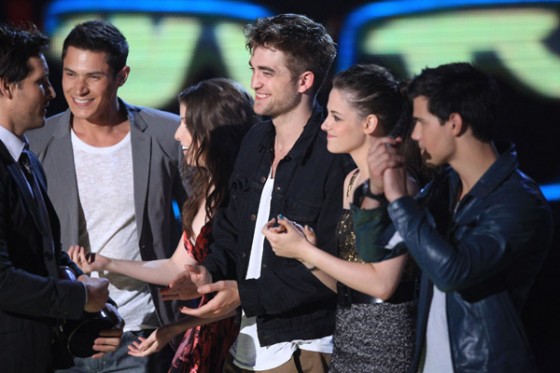 The Twilight Saga New Moon won the MTV Movie Award for Best Movie!
  Robert Pattinson won the MTV Movie Awards for Best Male Performance and Global Superstar!
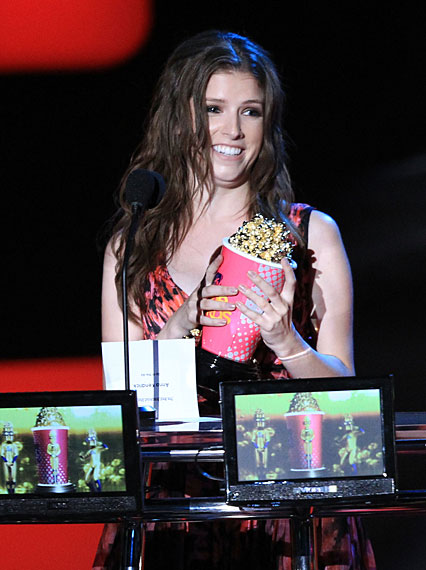 Anna Kendrick won the MTV Movie Award for Best Breakout Star for her role in Up In The Air!

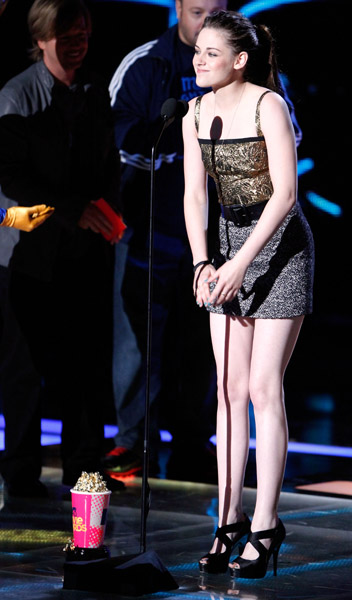
 MTV just revealed where Kristen Stewart and Robert Pattinson will sit at the MTV Movie Awards Sunday night!

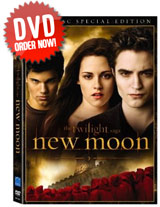 Buy New Moon on DVD!

 Twilight Journals
 New Moon "Team Jacob" Book Edition with Poster

 New MoonMovie Edition Paperback
 New Moon Soundtrack